If you’ve been searching for clear answers about Florida roof age insurance rules, you’re not alone. Across Palm Beach County—from West Palm Beach and Boca Raton to Delray Beach, Jupiter, Wellington, and Boynton Beach—thousands of homeowners are dealing with the same problem: an insurance market that has gotten extremely strict about how old your roof is and what condition it’s in.
There’s a lot of bad information floating around about Florida’s roof rules. This guide breaks down the actual law, what your insurance company can and can’t do under current Florida roof age insurance regulations, and what every Palm Beach County homeowner should be doing right now to protect their home and their policy.
How Florida Roof Age Insurance Rules Actually Work (Statute 627.7011)
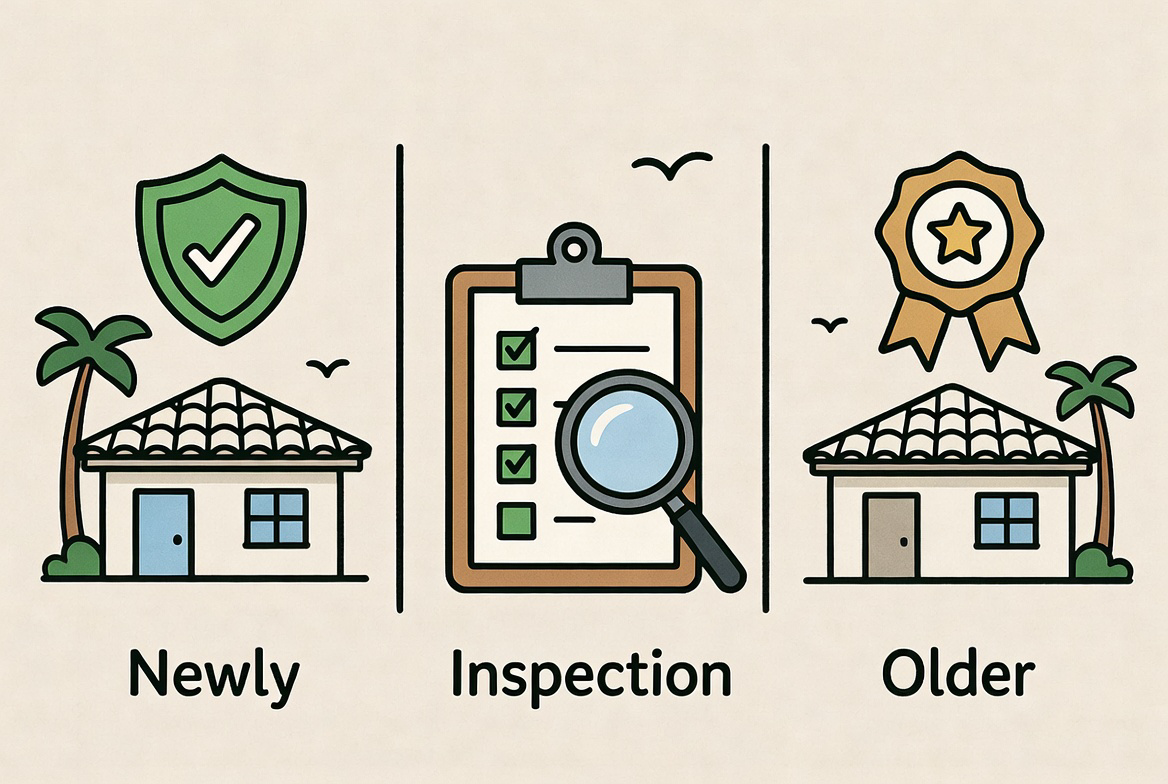
Florida Statute 627.7011 is the law that governs how insurers can use roof age in their underwriting decisions. It went into effect for policies issued or renewed on or after July 1, 2022. You can read the full text of the statute on the Florida Senate website, but here’s what it actually says in plain English:
- If your roof is less than 15 years old, an insurer cannot refuse to issue or renew your homeowners policy solely because of the roof’s age.
- If your roof is 15 years old or older, an insurer can require a roof inspection (paid for by the homeowner) before renewing or issuing your policy.
- If that inspection shows your roof has at least 5 more years of useful life, the insurer still cannot refuse to renew solely because of the roof’s age.
In other words: the law gives you protection, but it also gives insurers a clear path to demand inspections once your roof passes 15 years. And if the inspection comes back with less than 5 years of remaining useful life, your insurer can use that to non-renew you.
The Citizens Property Insurance “25-Year Rule”
Many Palm Beach County homeowners end up with Citizens Property Insurance—Florida’s state-backed insurer of last resort—when private carriers won’t cover them. Citizens publishes its own roof-age requirements that are stricter and more specific than the general state law (you can read them directly on the Citizens support site):
- Shingle roofs and other standard roofs: Citizens generally requires documentation of a full roof replacement if the roof is more than 25 years old.
- Tile, slate, clay, concrete, or metal roofs: documentation of full replacement is generally required if the roof is more than 50 years old.
- Either way, you also have to provide documentation showing the roof has at least 5 years of useful life remaining.
This is where the “25-year rule” you’ve probably heard about comes from. It’s not a state law that applies to every insurer—but if you’re a Citizens policyholder (and a huge number of Palm Beach County homeowners now are), it’s a hard line you have to plan around under Florida roof age insurance guidelines.
What About SB 4-D And The 25% Damage Rule?
There’s a second Florida roof rule that often gets confused with the age rule, and it’s worth understanding because it could save you tens of thousands of dollars after a storm.
Before SB 4-D passed in 2022, Florida had a “25% rule” that essentially required a full roof replacement if more than 25% of the roof was damaged. SB 4-D changed that. For roofs built or updated to the 2007 Florida Building Code or later, only the damaged sections need to be brought up to current code—not the entire roof.
For roofs built before March 2009, the older 25% rule still generally applies. So if your roof is older, even moderate storm damage can trigger a full replacement requirement under code.
[EDITOR NOTE: Internal link opportunity here → link the words “full replacement” or “replacement” to your existing blog: “Roof Repair Vs. Replacement: Which Option Is Best For Your Home?”]
What May Change In 2026: SB 808 And HB 815
Florida lawmakers have introduced new bills—Senate Bill 808 and House Bill 815—that aim to further restrict insurers’ ability to refuse to issue or renew a policy solely because of a roof’s age. As of this writing, these bills are pending and would take effect July 1, 2026 if passed in their current form.
Until then, the rules described above are what Palm Beach County homeowners need to plan around. And even if the new law passes, insurers will almost certainly continue to use roof age as a factor in inspections, premiums, and overall insurability decisions—just not as a sole reason to non-renew.
What Palm Beach County Homeowners Are Actually Seeing
We hear the same stories every week from homeowners across Palm Beach County dealing with Florida roof age insurance issues:
- Non-renewal letters citing roof age, condition, or failed inspections.
- Insurers requiring a wind mitigation or 4-point inspection before renewing—and then dropping coverage when the inspection finds significant wear.
- New buyers who can’t close on a home because no insurer will write a policy on the existing roof.
- Premium increases after a roof crosses the 15-year mark and inspections start getting required.
- Homeowners pushed onto Citizens, then bumping up against the 25-year shingle / 50-year tile threshold a few years later.
What You Can Actually Do About It
Here’s the practical playbook for Palm Beach County homeowners trying to protect their insurance and their home:
- Get a professional roof inspection before your insurer asks for one. A trusted local roofer can tell you exactly how much usable life your roof has left and what an inspector is likely to flag.
- Get a wind mitigation inspection. This is a separate report (done by a licensed inspector) that documents how well your roof resists wind. A strong wind mit report can save you significant money on premiums—even if your roof is older.
- Address small repairs immediately. Lifted shingles, damaged flashing, exposed nails, soft spots—these are exactly the issues that turn into non-renewals. Fixing them before your insurance inspection is far cheaper than losing your policy over them.
- Document the “useful life” of your roof. Statute 627.7011 is built around the 5-year-remaining-useful-life standard. A formal inspection report stating your roof has 5+ years left is one of the strongest documents you can have on file.
- Plan ahead if you’re close to a threshold. If your shingle roof is 22 or 23 years old and you’re with Citizens, you’re a couple of renewal cycles away from a forced replacement. Doing it on your timeline is almost always cheaper than doing it on theirs—especially if you can avoid hurricane-season pricing.
- Choose materials that insurers love. When you do replace, modern impact-resistant shingles, properly installed tile, and metal roofs can qualify for better insurance discounts and longer coverage windows.
Why Acting Now Saves You Money And Your Policy
A roof you replace on your timeline is dramatically cheaper than a roof you’re forced to replace on your insurance company’s timeline. That’s the bottom line of every Florida roof age insurance conversation we have with homeowners.
Wait until you get a non-renewal notice and you’re negotiating from a position of weakness. You’re working against a clock. You’re competing with every other Palm Beach County homeowner who got the same letter. And you’re probably doing it right as hurricane season pushes labor and material prices up.
Get ahead of it now and you’re in control: better pricing, more contractor options, time to compare estimates, and a roof that locks in your insurability for the next 20+ years.
How All-Type Roofing Services Can Help
All-Type Roofing Services has helped Palm Beach County and Treasure Coast homeowners navigate Florida roof age insurance issues more times than we can count.
We’ll come out for a free roof inspection, give you an honest assessment of your roof’s condition and likely insurance standing, and walk you through your real options—repair, partial replacement, or full re-roof. No pressure. No scare tactics. Just straight answers from a licensed, insured Florida roofing team that knows what your insurer is looking for.
If your insurance company is starting to ask hard questions about your roof, the smartest thing you can do is get ahead of the answer. Call All-Type Roofing Services today and let’s take a look before your next renewal letter shows up.
Sources & Further Reading
- Florida Statute 627.7011 (Florida Senate)
- Citizens Property Insurance — Roof Age Requirements
- Florida Roof Age Rules and Insurance Nonrenewals — GreatFlorida
Note: Florida insurance law and insurer underwriting practices change frequently. Confirm specifics with your insurance agent or carrier before making decisions. This article is for general information, not legal or insurance advice.